Rebalancing Tiers & Rules
The Intelligence & Strategy Layer is responsible for deciding when, where, and whether to move your capital. At its core is Smart Rebalancing v.2: a rule-based engine that continuously evaluates yield opportunities across all supported chains and protocols.
This page covers two key components: how rebalancing frequency scales with your deposit size, and the safety checks every rebalance must pass before execution.
Balance Tiers
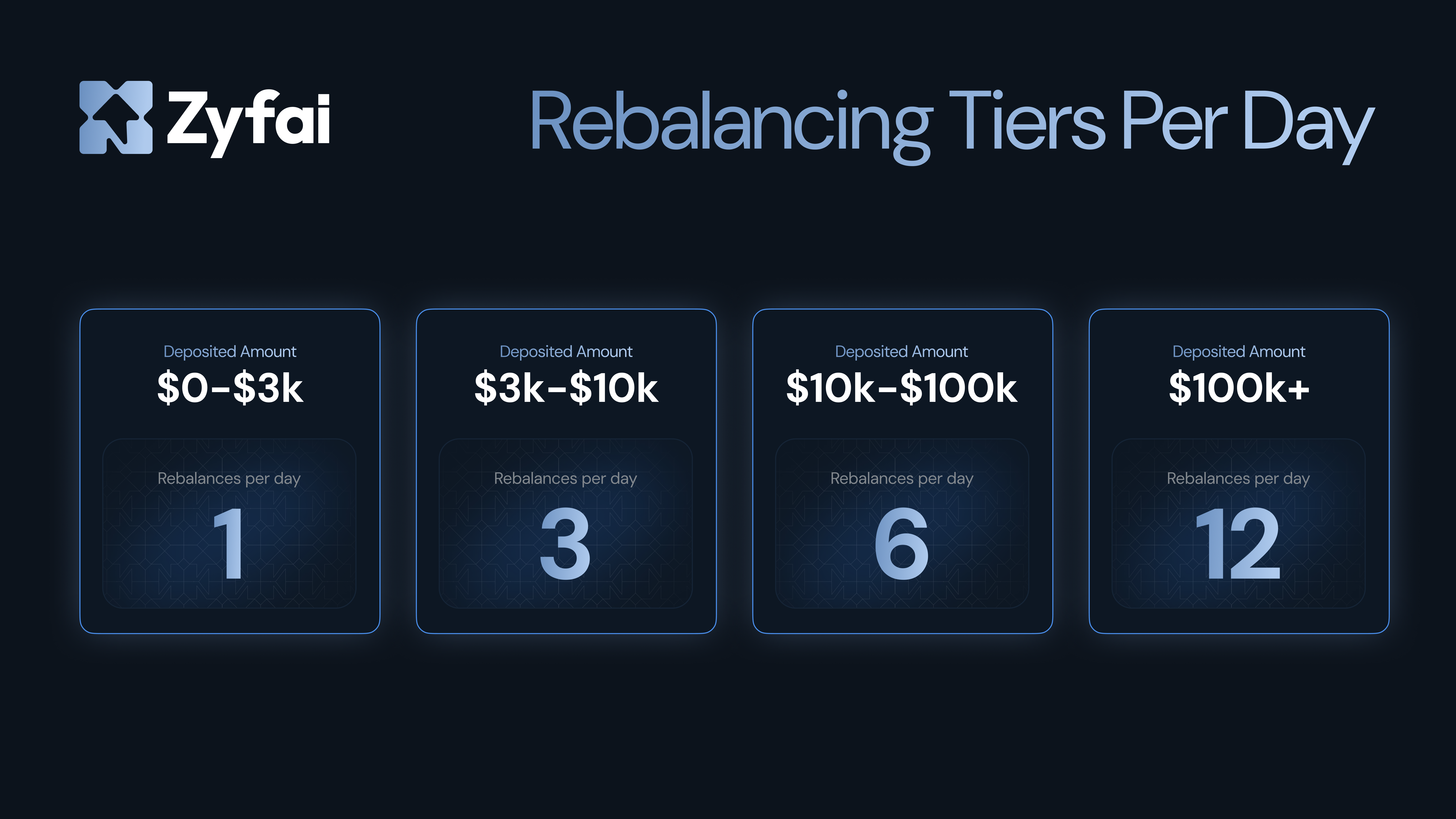
Not every portfolio needs to be checked at the same cadence. Smaller deposits benefit from staying in a single position longer, while larger balances can justify more frequent rebalancing, provided the yield gain outweighs the cost.
To keep this fair and efficient, Zyfai tiers the Agent's rebalancing frequency based on the size of your deposit. You get more attention when it matters most, and the system doesn't waste resources chasing negligible gains on small positions.
Backtests
We've run extensive simulations to see how rebalancing frequency affects returns. Starting with a static strategy, where funds stay in the same pool regardless of market shifts, we compared Smart Rebalancing v.2 against portfolios from each tier and our previous rebalancing engine.
The results are clear: dynamic rebalancing improves yield across the board. Even a single daily rebalance tends to outperform a static strategy over time. Increasing the frequency further produced incremental gains, reflecting the value of reacting quickly to changing APYs.
Smart Rebalancing v.2 consistently outperforms the previous engine. Each optimization contributes to faster, more accurate decision-making, allowing Agents to identify and act on yield opportunities while minimizing unnecessary movements and gas costs.
The result is a rebalancing system that's not only more efficient but also demonstrably more profitable across all tiers of capital:
| Balance | Rebalances per Day | Average 30d APY (w/o rZFI) |
|---|---|---|
| Average static strategy | 0 | 7.84% |
| 3,000 | 1 | 13.23% |
| 10,000 | 3 | 16.71% |
| 100,000 | 6 | 18.81% |
| $100,000+ | 12 | 19.13% |
Allowing the Agent to search for better yield more often translates into better returns. And because the Agent always weighs benefits against costs (slippage, gas, and other fees), it only moves your funds when it makes economic sense. In practice, your funds capture more upside while still benefiting from the same disciplined, safety-first approach that Zyfai users expect.
Rebalancing Rules

Behind every rebalance is a set of safety and efficiency checks designed to protect your capital and maximize returns. Before shifting any position, the Agent runs five tests.
1. Pool Safety
Before entering a new opportunity, the Agent compares the pool's total size to your wallet balance. It prefers pools significantly larger than your position so you don't end up owning a disproportionate share of the liquidity. This minimizes the impact of a sudden reduction in the pool's TVL. If a pool shrinks unexpectedly (e.g., after a large exit), the Agent will exit your position rather than leave funds stranded in a shallow market.
2. Meaningful Yield Difference
Not every uptick in yield is worth chasing. The Agent calculates the difference between your current yield and the potential yield in the target pool. Only when the improvement crosses a meaningful threshold will it consider rebalancing. Minor differences are ignored to avoid unnecessary costs.
3. Yield Stability
A high APY is not useful if it disappears overnight. The Agent reviews a week's worth of yield data for the target pool. If the yield has been relatively steady (not dramatically spiking or crashing), the pool passes this test. This allows the Agent to capture upside without jumping into unstable opportunities.
4. Profit vs. Transaction Costs
Every move incurs slippage and fees. The Agent estimates how much additional yield the new pool would generate daily and compares it to the one-off cost of moving your funds. It then calculates how long it would take for the extra yield to cover those costs. If the payback period is short enough, the Agent proceeds. Otherwise, it waits for a better opportunity.
5. Money Market Liquidity
The Agent monitors liquidity, utilization and the Interest Rate Model (IRM) of each money market. When a market becomes highly utilized and remaining liquidity shrinks to a level that could affect withdrawals, the Agent proactively exits your position. This avoids situations where your funds become illiquid or yield deteriorates because the market is overcrowded.
By combining these five checks, Zyfai Agents capture higher returns without taking on unnecessary risk or incurring excessive costs.
Once a rebalance passes these checks, it is executed through the Execution & Verifiability Layer, where every action is validated by the Security Proxy Gateway and can be cryptographically proven via ZK proofs anchored in the ERC-8004 registry.