

- Protocol-level risks
- Collateral-level risks
- Pool-level risks
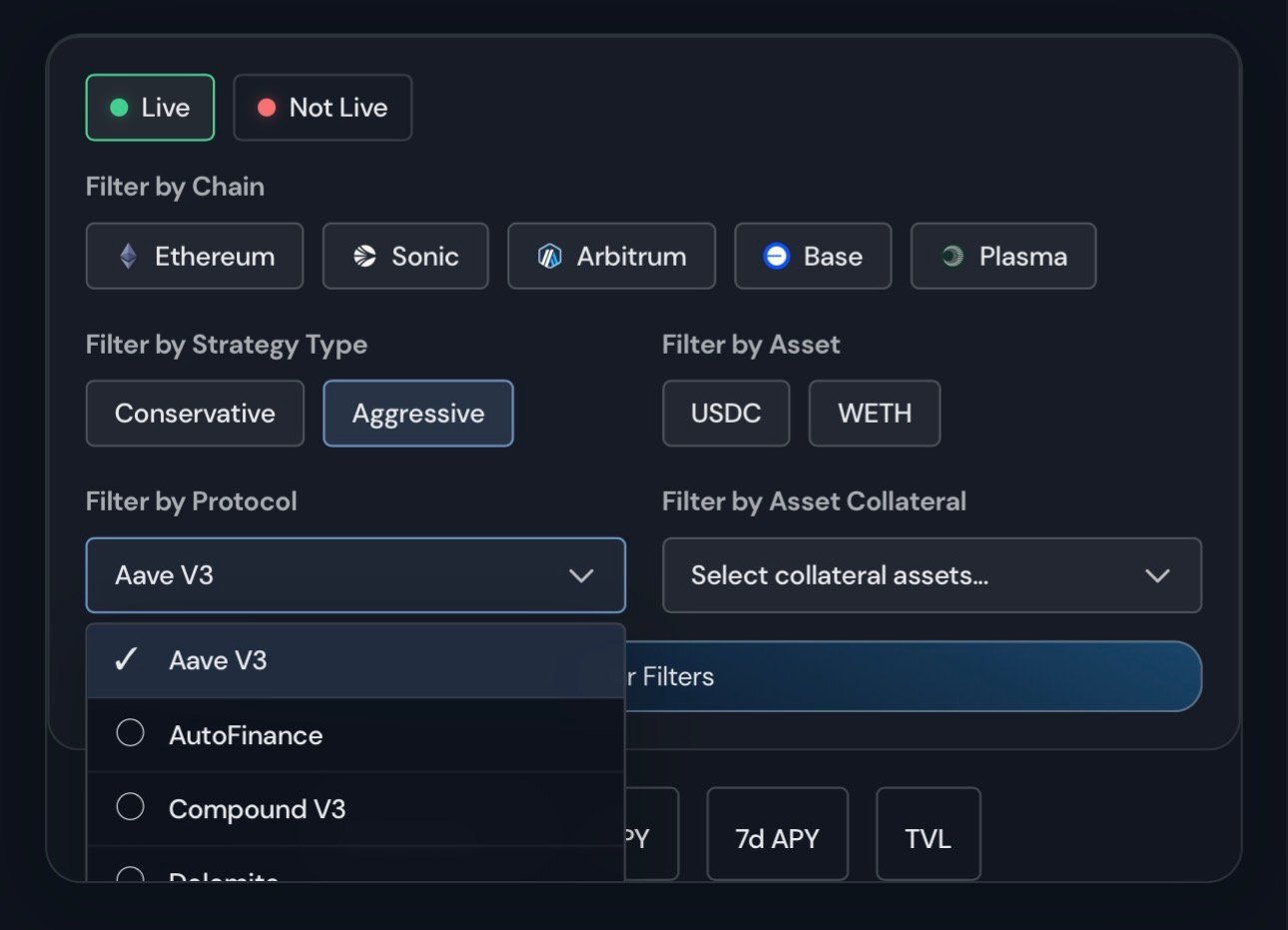
Live risk data: risk.zyf.ai
Strategy Tiers
Pools are classified into three risk-tiered strategies. Return expectations are averaged across market cycles on an approximate 3-year time horizon.Conservative
Target native return (excluding incentives): 5–8% The Conservative strategy allocates exclusively to the most liquid, battle-tested pools and protocols. It prioritizes capital preservation above all else. Key constraints:- USDC only: no collateral swaps, no dual-LP positions requiring stablecoin swaps
- No principal tokens (PT)
- Protocol must have $100M+ TVL and 36+ months live
- Pool TVL ≥ $1M, liquidity ≥ $500K
- No Leverage or Looping
Aggressive
Target native return (excluding incentives): 8–14% The Aggressive strategy includes all Conservative criteria with relaxed thresholds, opening access to higher-yielding opportunities with riskier collaterals and principal tokens. Key differences from Conservative:- Riskier collaterals and principal tokens (PT) are permitted
- Protocol must have $25M+ TVL and 12+ months live
- Pool TVL ≥ $250K, liquidity ≥ $100K
Yield Maxxing
Target native return (excluding incentives): 10–18% The Yield Maxxing strategy includes all Conservative and Aggressive pools with async vaults (ERC-7540) added, subject to withdrawal period of 72 hours. Key differences from Conservative and Aggressive:- Includes async vaults (ERC-7540)
- Protocol must have $10M+ TVL and 12+ months live
- Pool TVL ≥ $100K, liquidity ≥ $50K
For more on how strategies are selected and customized, see the Yield Strategies page.
Whitelisting Process
Before any pool is made available on Zyfai, it must pass through a structured whitelisting process covering the protocol, its collaterals, and the individual pool.Protocol Whitelisting
Each new protocol undergoes a comprehensive due diligence review. Technical Risks- Smart contracts audited by multiple renowned audit firms
- Audit less than 1 year old, or code unchanged since last audit
- No unresolved critical findings
- Use of tier-1 oracles (e.g. Chainlink, Pyth): no reliance on single DEX TWAP
- Exploit history reviewed; zero exploits in the past 12 months
- Team has a relevant DeFi track record
- Active development (GitHub commits in the last 30 days)
- Multisig with ≥5 signers, ≥3 required: no single individual can rug
- Governance token distributed (top 10 holders < 50%)
- Source of yield assessed: sustainable fee-based models preferred over temporary incentives
- Can exit 100% of position with < 3% slippage
- Pool is permissionless: no withdrawal queue, no NAV calculation
- For lending pools: exposure limited to whitelisted collaterals only
- Conservative requires 36 months live and $100M TVL
- Aggressive requires 12 months live and $25M TVL.
Collateral Whitelisting
Each collateral asset accepted in a lending pool is independently assessed. Data sources include CoinGecko, Chainlink/Pyth price feeds, GeckoTerminal/DexScreener, and official protocol documentation. The assessment covers backing ratios, price stability (depeg history), market capitalisation, onchain liquidity, and trading volume. An asset qualifies for a tier only if it passes every criterion for that tier:
The minimum backing ratio depends on the asset category:
A depeg only counts when it lasts at least 8 hours with at least $5K of trading volume, so short wicks on thin markets are ignored. Assets missing data on two or more criteria are flagged as having insufficient data rather than being classified.
Pool Identification
New pool opportunities are identified and reviewed on a daily basis. Each pool must meet the TVL and liquidity thresholds of its target strategy and must be hosted on an already-whitelisted protocol with whitelisted collaterals.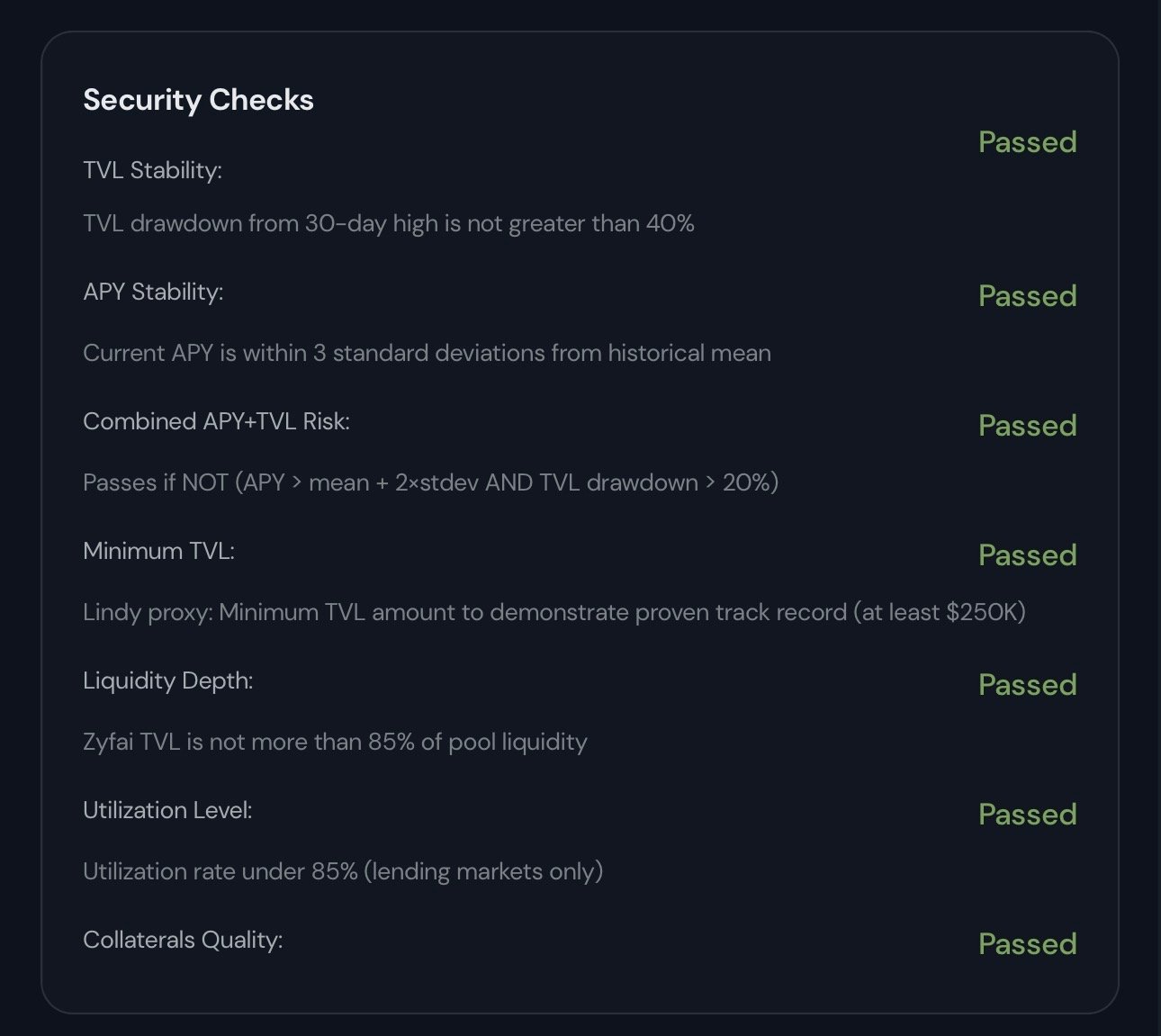
Continuous Monitoring
Once a pool is live on Zyfai, it enters a continuous monitoring pipeline. These checks run automatically and are visible on the Risk Dashboard.Collateral Monitoring
All collateral whitelisting criteria are re-evaluated on a monthly basis. In addition, the following events are continuously monitored:- Stablecoin depeg events: real-time detection of peg deviations for both base assets and collateral stablecoins in lending pools
- New collateral additions: when a curator whitelists a new collateral, it is automatically flagged and reviewed against listing criteria (liquidity, peg stability, backing)
Pool Monitoring
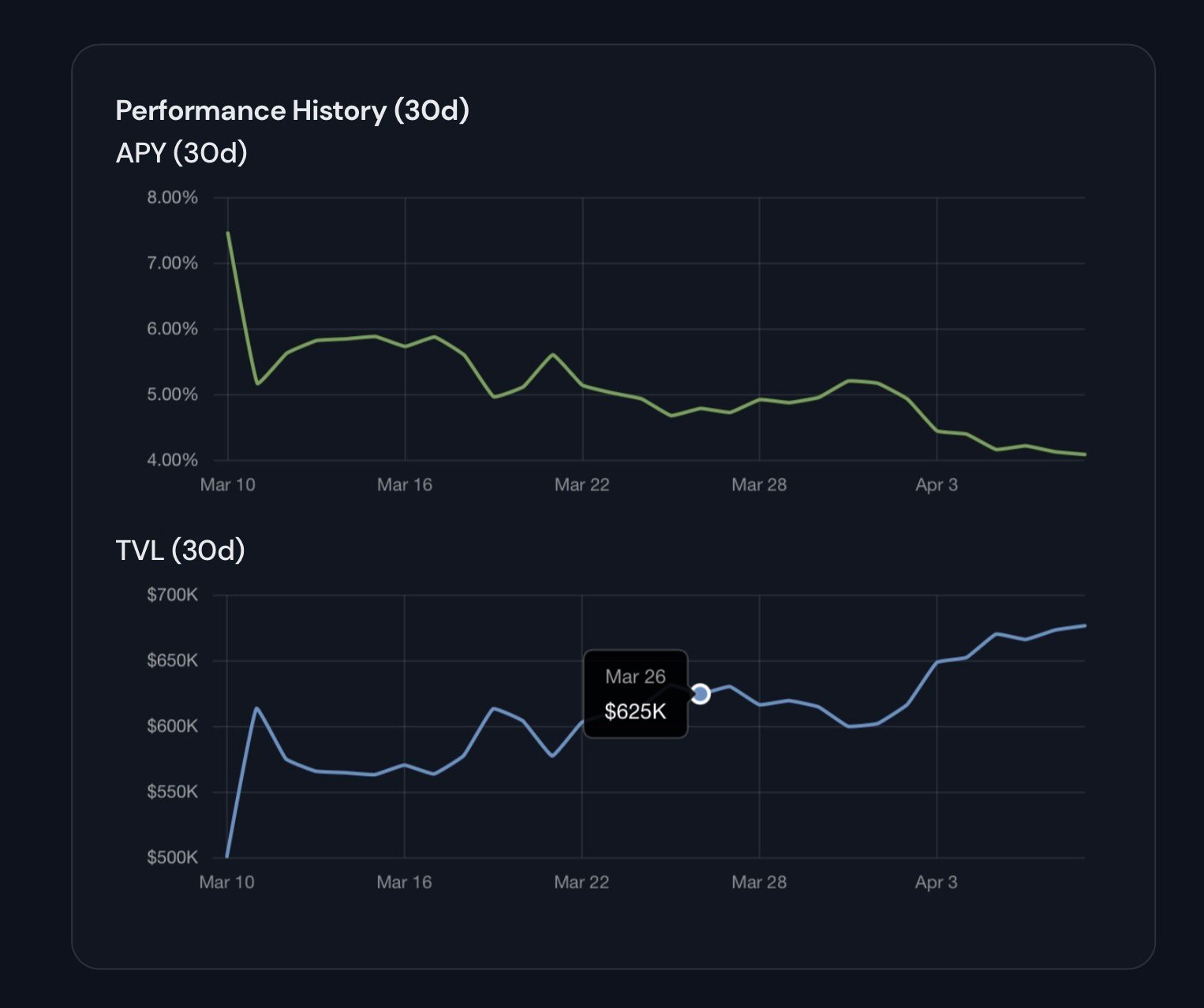
- TVL stability: flagged if there is a 40% drawdown from the 30-day high
- Combined APY + TVL check: flagged if APY deviates by 2σ and TVL draws down 20% simultaneously
- Liquidity vs. Zyfai TVL: ensures Zyfai’s exposure remains a safe fraction of available pool liquidity
- Strategy classification review: ongoing assessment that each pool is correctly categorized as Conservative or Aggressive
Vault Structure Review
For protocols with hierarchical vault structures (e.g. Morpho curators), the complete allocation hierarchy is mapped: which underlying markets each vault allocates to, which collaterals are accepted, and how capital flows through the structure. This is reviewed continuously as curators adjust allocations.Risk Alerts
Zyfai provides real-time risk intelligence notifications covering the following events:- Depeg event on the base asset
- Liquidity trap issue
- Pool not live