Technical Implementation
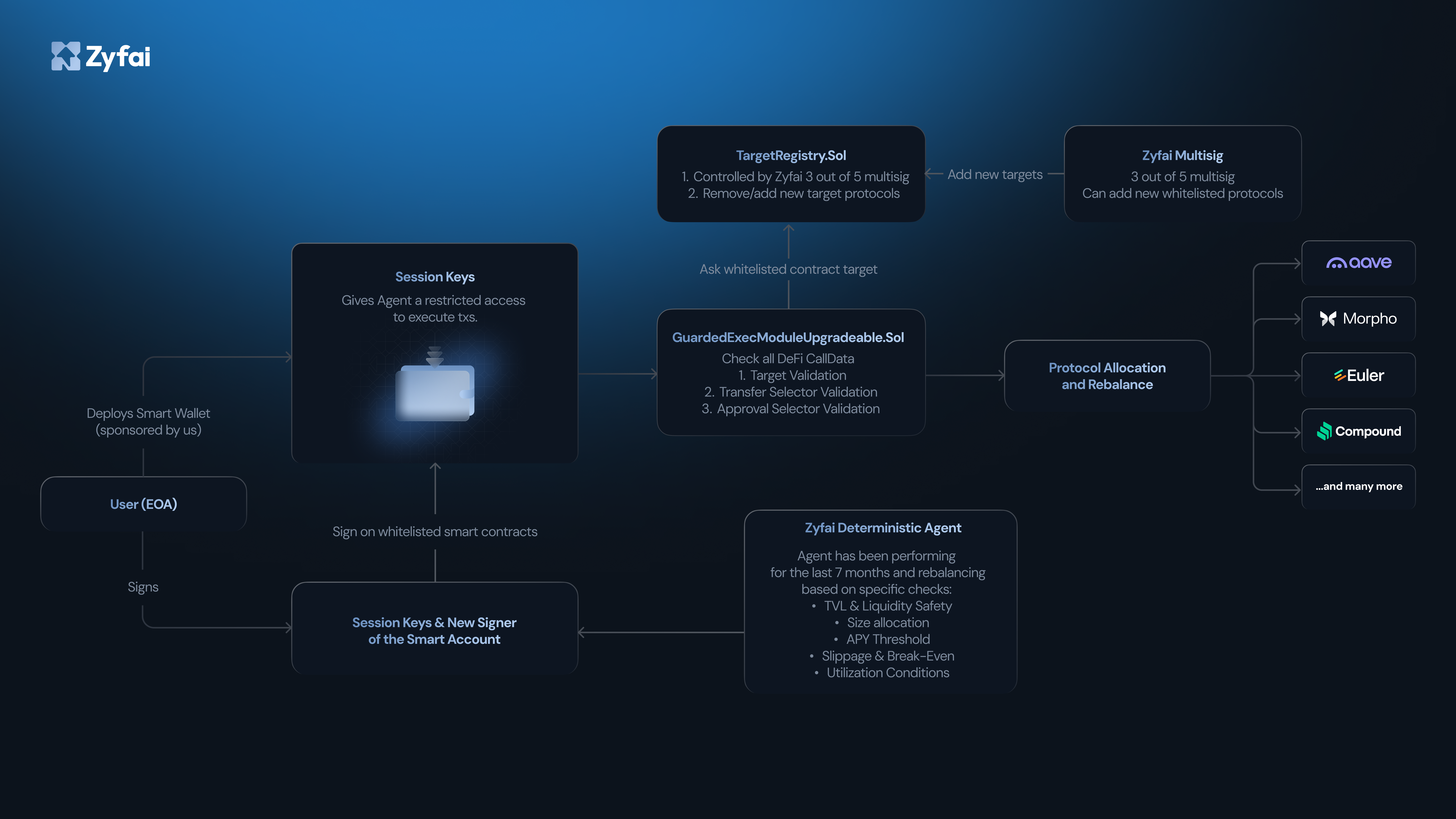
The Zyfai Smart Account is based on 3 core components:
- Smart Account
- Session Keys
- Agent
Smart Account
On Ethereum, there are two types of accounts: Externally Owned Accounts (EOAs) like Metamask or Rabby, and Smart Contract Accounts.
Popularized by the ERC-4337 proposal, smart contract accounts can transfer and receive tokens on the blockchain but rely on code instead of a private key to secure and recover wallet information.
The benefits of these Smart Accounts are numerous, including:
- Transaction batching
- Gas sponsorship via paymasters
- Session key support
That's why, when you deposit funds through the Zyfai agent, it automatically deploys a fresh and new smart account on your behalf to manage the funds you just deposited.
Session Keys
Zyfai uses Session Keys, which are simple keys that provide temporary access to a user's account with specific permissions.
This is especially useful when a user wants to allow an app to execute transactions on their behalf. Zyfai users sign a session key which gives a restricted access to what the agent is allowed to do.
During the onboarding process, you will select the networks and protocols you are comfortable engaging with, guided by your personal risk management.
By doing this, you are configuring the agent to interact with specific protocols' smart contracts based on your choices. The strength of session keys lies in their ability to limit actions based on predefined permissions.
The Agent
The Agent is optimizing your yield by rebalancing your funds across DeFi protocols and chains to capture the highest available yields. He is actually running on 4 chains, Base, Arbitrum, Sonic and Plasma and only using USDC.
The agent is an off-chain infrastructure which is looking to many guardrails rules to ensure your funds are always rebalanced into the most optimal opportunity or pool. Not only is the yield of each underlying pool monitored, but multiple parameters, such as the interest rate model, TVL, APY stability, slippage, and price impact are also taken into consideration.